

In 2026 I've had more opportunities to practice Radical Acceptance than I've ever had before. I'll spare you (for now) the laundry list of circumstances I never thought possible that I've tackled this year, but the world changed immensely, and I am at its mercy. I can't say whether a massive shift in one's worldview is typical to the human experience of middle aging, or if my permanent suspension of disbelief is a consequence of witnessing some of the worst moments in American history, but I will accept as possible any new bullshit thrown my way.
Amid the shakubuku, one of the easiest shifts I've accepted is that the technologies under the umbrella of Artificial Intelligence are not going away and are, thank goodness, kinda sorta delivering on what they initially promised. I'm able to make and talk with spreadsheets via Claude, and the tool completes the task without much trouble. Like nearly 50% of Americans who use AI several times a week, I've learned to chatbot, refined my prompts, and accepted that we aren't stopping the giant AI boulder rolling down the hill. Sure, it's a bubble and yes! there are all kinds of issues with LLMs. But now that the technology seems to be working fairly well, I accept that organizing and accessing information will be primarily natural language-based within the next five to twenty years.
A couple of months ago, I caught a classic story of Radical Acceptance: The Rocky Horror Show on Broadway. Thematically, Rocky Horror is about the acceptance of sexuality, perversion, and queerness, but it's also literally a story about accepting your fate. Sometimes your car dunzos-out right near the Frankenstein Place, and you have no choice but to consort with the keepers of the castle, who happen to be a crew of aliens from the planet Transsexual in the galaxy of Transylvania.
One of those aliens, Dr. Frank-N-Furter, is a mad scientist on the verge of revealing his newest creation: a perfect life-form built from scratch. Frank-N-Furter shares many traits with the CEOs of top AI companies: he's a total monomaniacal weirdo who believes in his own superiority, subjecting everyone in his path to his vision. His flunkies agree with everything he says, even when it seems a little off. His invention is his idea of a perfect man who can serve his needs: Rocky, a swole dumb guy who runs around in little shorts.
When the mad doctor seeks praise from his entourage for his invention, two of his three sidekicks praise his accomplishments as "pure genius" and "a triumph of your will." The third sidekick, a sassy lass named Columbia, regards the new invention of Rocky and exclaims: "He's okay!"
Columbia's pronouncement is how I feel about using Claude: He's okay! The bot doesn't resemble what I would personally develop, were I the CEO of an AI company. After many sessions, its voice grates, its commentary is predictable, its pulsating sphincter logo is cringe-inducing, and its problem-solving methods are recursive and weirdly self-flagellating. When its output doesn't hit the intended mark, it feels like the juice might not be worth the squeeze. I certainly wish it took fewer resources and less money to create, and I wish that it weren't readily accessible to the worst people during the most tumultuous political period of my lifetime.
But it does help me complete a good deal of complex, programming-adjacent work, in a way that I have never experienced before. I accept it, radically. It's okay. It's not going away.
Zhuzhing up the website and organizing the archive
With Claude Code, I've launched a new design for The Content Technologist and tweaked the theme to my liking, even though I have precious little skill coding in CSS or Javascript. If you haven't been to the website in a bit, take a look.
To test how the tool understands and sorts content—the kind of work I do regularly as an information architect and search expert—I asked it to sort through my entire six-year archive and identify The Content Technologist's top 25 strongest essays. It didn't do this particularly well at the start, since only five of its initial selections made the final cut. It initially favored the political and "crisis writing" over the technical explainers or meandering essays I prefer. But I was impressed by its ability to extract themes and meaning (or the predictive-text illusion of meaning) from my weirdest, most complex writing. The thing can read, if not perfectly. Kinda like a human.
So, The Content Technologist has been reorganized and rearchitected, as I reach the end of my sixth year newslettering. Although client work is my top priority (and why I have been absent), I am making a concerted effort to stop filling my notebook with unsent, overly complex screeds and return to regular publishing. A writing practice is therapeutic when it's not outright painful, and it's done wonders in helping me process the unprecedented events and complicated emotions that I've Radically Accepted since 2019.
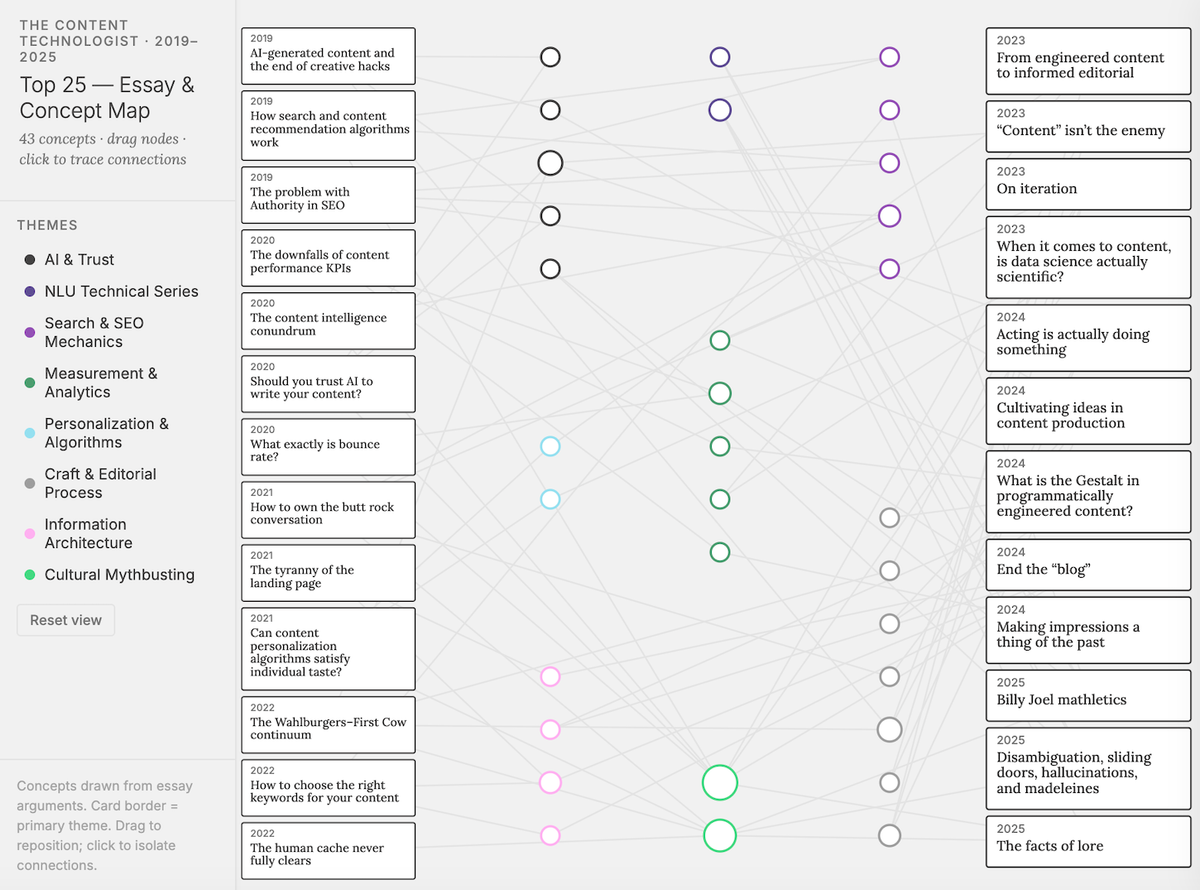
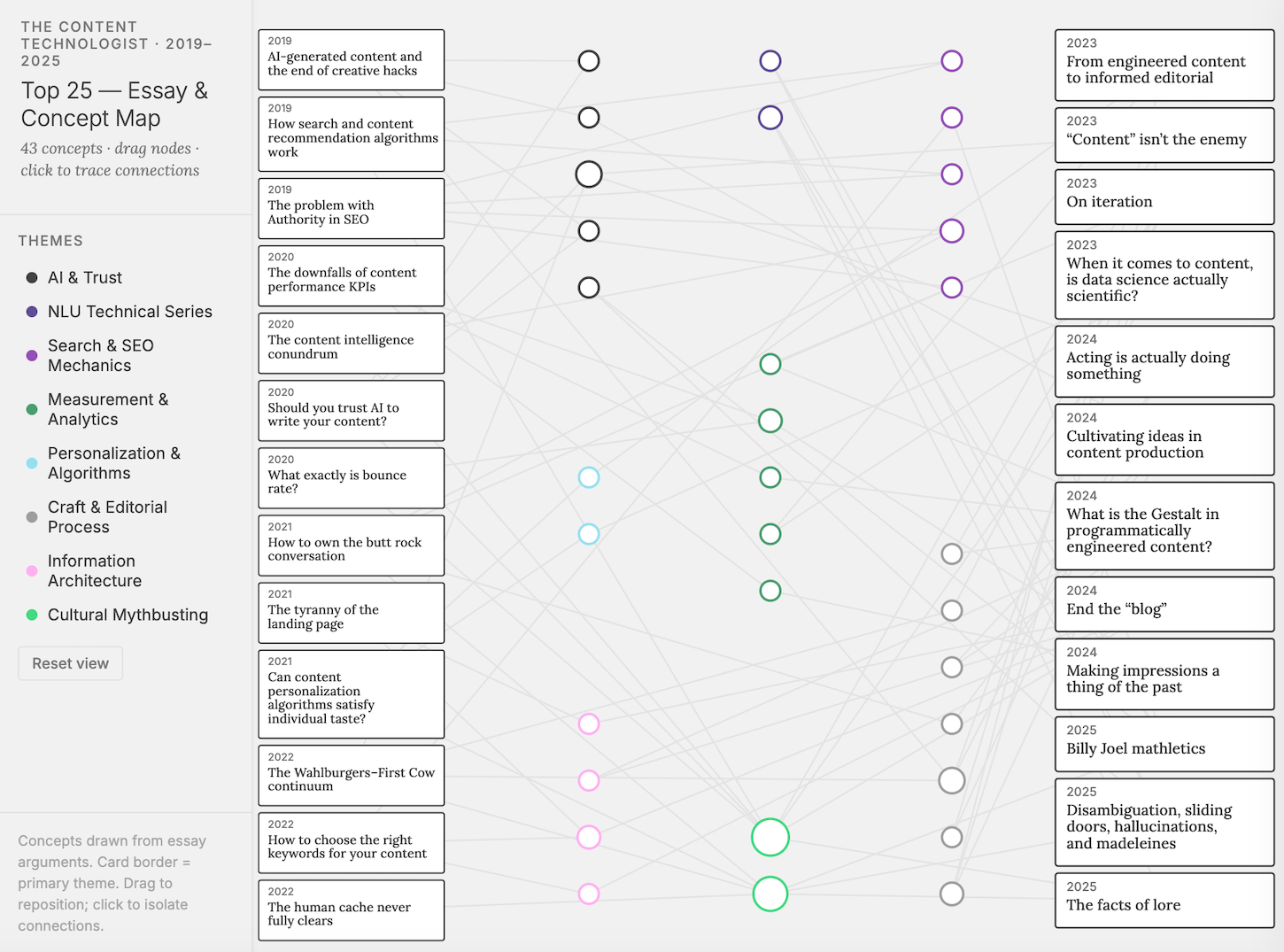
In the meantime, here's where I've been: 25 essays that represent the best of The Content Technologist. With the help of the machine, I've also created a knowledge graph–style visualization that links the top 25 essays in the archive identified by each entry's most prominent themes. It's not perfect. An experienced digital designer will find all kinds of problems with it. But it works, and it only took three sessions to compile and debug.
I still don't use Claude, or any bot, to construct the sentences or determine the structure in this newsletter. I don't agree when it tells me any particular sentence is "doing the work" or is "load-bearing." But I do find it helpful, as an expert in the language of search, to explore how it understands and recommends language.
More on my many thoughts around the new software ecosystem soon. In the meantime, dig the past. Radically accept the present. The thing is here, it's okay, it is changing how we work, and we are in it for the long haul.
The top 25 essays in The Content Technologist*
To navigate these essays by theme, check out the visualization. These essays were chosen with the help of Claude, ordered by most fun to read, according to the bot.
Here's the full list, in fun-to-read order, with full titles linked and publish dates:
- How to own the butt rock conversation (2021-03-02)
- Mass-produced iteration vs. collaborative auteurs: The Wahlburgers–First Cow continuum (2022-12-29)
- Billy Joel mathletics: How query fan-out identifies and interprets our weird world of words (2025-09-12)
- Disambiguation, sliding doors, hallucinations, and madeleines: How transformers process, clarify, and produce language (2025-08-25)
- The facts of lore: What happens when the most reputable information on the internet is about fiction? (2025-01-10)
- Can content personalization algorithms satisfy the multitudes of personal taste? (2021-09-05)
- Should you trust AI to write your content? (2020-02-13)
- On iteration: Why digital business folks and content producers don't always see eye-to-eye (2023-04-13)
- When it comes to content, is data science actually scientific? (2023-12-08)
- What exactly is bounce rate?: Post-structuralism and content analytics (2022-08-03)
- From engineered content to informed editorial: Blazing new trails in digital publishing (2024-02-19)
- The downfalls of content performance KPIs (2020-08-13)
- Acting is actually doing something: On craft and its role in content production (2024-04-17)
- The tyranny of the landing page (2021-04-23)
- AI-generated content and the end of creative hacks (2019-08-08)
- How to choose the right keywords for your content, OR True tales of a newbie content manager (2022-11-10)
- How search and content recommendation algorithms work (2019-11-21)
- The problem with Authority in SEO (2019-11-28)
- Cultivating ideas in content production: This one weird trick will separate the bots from the professionals (2024-03-08)
- What is the Gestalt in programmatically engineered content? (2024-07-16)
- The content intelligence conundrum: Why AI alone won't fix your content problem (2020-09-03)
- End the "blog": Why are you hiding all your best content in a single feed? (2024-08-30)
- "Content" isn't the enemy: Keeping content creative, not generative (2023-10-06)
- Making impressions a thing of the past: Grounding your content performance data in reality (2024-07-02)
- The human cache never fully clears (2022-04-07)
*I've written most issues of this newsletter over the past six years, but in this roundup, I have not included essays from other authors written during 2023. They are awesome essays! But in this exercise I wanted to explore the archive of my own writing, since The Content Technologist has been, most of the time, a personal project.
Enjoy the archive. If these essays are new to you, I'd love to hear what you think.
And happy Pride! The easiest thing to radically accept is queer culture and a spectrum of sexuality, as far as I'm concerned.
—DC
The Content Technologist is a newsletter and consultancy based in Minneapolis, working with clients and collaborators around the world. The entire newsletter is written and edited by Deborah Carver, an independent content strategy consultant.
Affiliate referrals: Ghost publishing system
Cultural recommendations / personal social: Spotify | Instagram | Letterboxd | PI.FYI